
The real estate market in Gurgaon, often characterized by its rapid transformation from an agrarian landscape to a global corporate hub, has entered a period of profound structural maturity as of 2026. For the premium buyer—defined here as the high-net-worth individual (HNI), the non-resident Indian (NRI), and the institutional family office—the traditional binary choice between a new project launch and a ready-to-move-in asset has been fundamentally reconfigured. This transition is not merely a byproduct of price appreciation but is rooted in a shift from speculative momentum to a disciplined, execution-led environment where risk-adjusted decision-making is the primary driver of capital preservation.
Why This Question Matters More in 2026 Than Before
The decision between a new launch and a ready asset in 2026 carries a weight that was largely absent in the previous decade. Between 2021 and 2024, the Gurgaon market experienced a “value revolution,” where property prices in prime corridors surged by as much as 150% to 160%. During that period, the sheer velocity of the market often masked underlying structural risks; almost any entry point appeared profitable. However, the current landscape is defined by elevated ticket sizes that have moved the median entry point for premium housing from ₹2.5 crore to upwards of ₹6 crore to ₹15 crore.
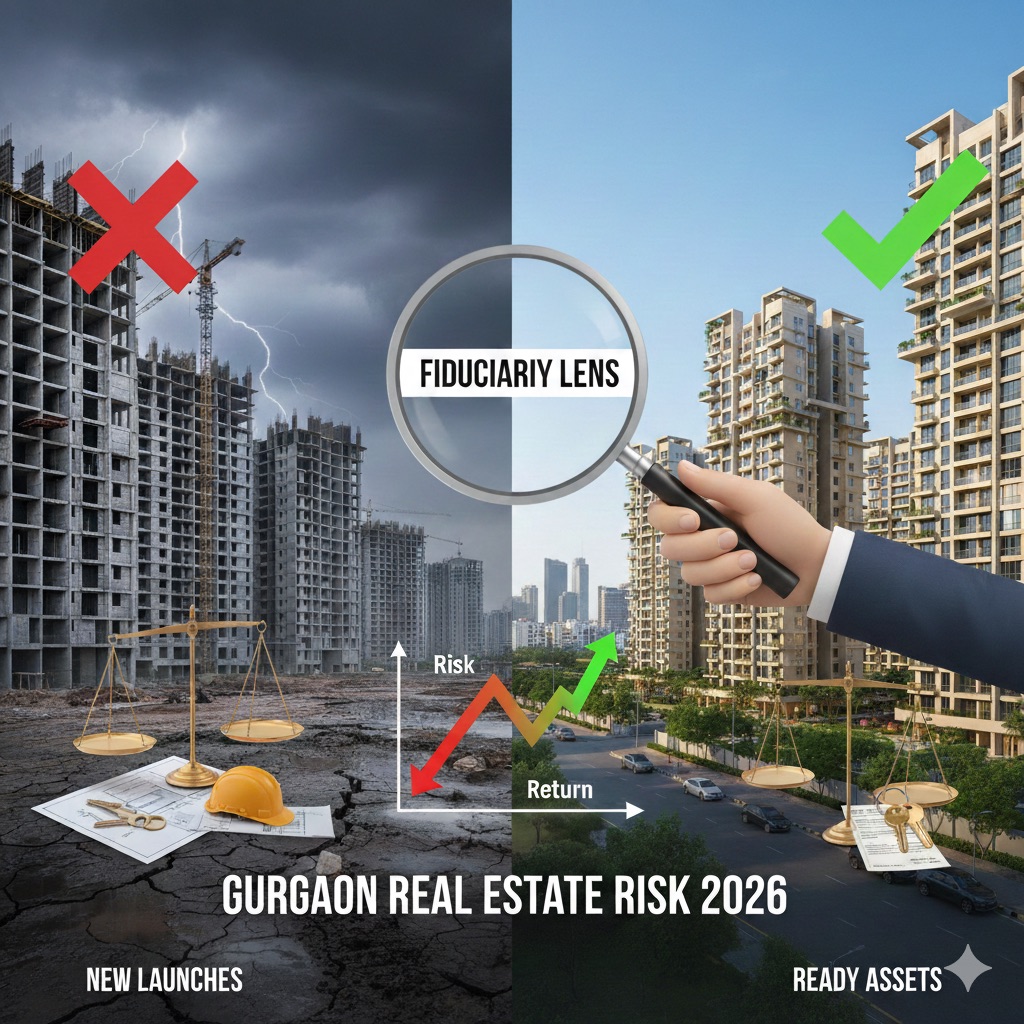
At these capital commitment levels, the margin for error has narrowed significantly. The market is no longer a “rising tide” that lifts all assets. Instead, it is a fragmented ecosystem where returns are localized within specific micro-markets and tied to the delivery of actual infrastructure rather than the promise of it. Furthermore, the profile of the market has shifted from short-term traders looking to “flip” properties to long-haul players focused on long-term livability and wealth preservation. This maturity necessitates a move away from marketing brochures and toward a fiduciary lens that prioritizes capital safety.
| Market Characteristic | Speculative Phase (Pre-2025) | Mature Phase (2026 onwards) |
| Primary Valuation Driver | Future promise and sentiment | Infrastructure execution and livability |
| Median Premium Entry | ₹2 crore – ₹4 crore | ₹6 crore – ₹15 crore |
| Investor Horizon | 12 – 24 months (Flipping) | 5 – 10 years (End-use/Yield) |
| Risk Sensitivity | Low; masked by rapid growth | High; driven by capital quantum |
| Regulatory Climate | Early RERA implementation | Advanced enforcement and technology |
Understanding the Risk Profile of New Launches
New launches in 2026 represent the “frontier” of the Gurgaon market. They offer the latest in architectural innovation, sustainable building practices, and integrated lifestyle amenities. However, the institutional perspective views these not as homes, but as under-construction liabilities until the moment the Occupancy Certificate (OC) is granted. The risks inherent in these assets are multi-dimensional, ranging from developer solvency to the sequencing of state approvals.
Construction and Delivery Risk in an Inflationary Environment
One of the most significant, yet often underestimated, risks in new launches is the developer’s ability to navigate the cost of completion. While prices have stabilized, the cost of construction inputs—including steel, cement, and skilled labor—has remained at historically high levels. A developer who has sold out a project at 2023 price levels may find their margins severely compressed by the time of actual construction in 2026.
This margin compression can lead to “specification drift,” where the final quality of the asset does not match the initial brochure promises. Furthermore, the risk of delivery delay is not merely a matter of convenience. For an asset priced at ₹10 crore, a two-year delay represents an opportunity cost of capital exceeding ₹1.5 crore to ₹2 crore when accounting for lost rental yields and the cost of alternative financing.
Regulatory, RERA, and Approval Sequencing Risk
The Haryana Real Estate Regulatory Authority (HRERA) has matured into a sophisticated governing body by 2026. However, the presence of a RERA registration number is a baseline requirement, not a guarantee of safety. Buyers must understand the sequencing of approvals. A project may have RERA registration but lack final environmental clearances or height NOCs from the Airports Authority of India, particularly in corridors proximal to the IGI Airport like the Dwarka Expressway.
The 2025-2026 RERA amendments have introduced stricter quarterly compliance requirements, where developers must submit detailed Form 1 (Architect), Form 2 (Engineer), and Form 3 (Chartered Accountant) certificates. Any gap in these filings is a leading indicator of project distress. Furthermore, the “Escrow Account” mechanism, while designed to protect 70% of buyer funds, is only as effective as the developer’s sales velocity. If a developer fails to sell their remaining inventory in a moderating market, the escrow funds alone may be insufficient to complete the structure.
Cash Flow Dependence and Developer Balance Sheets
In the premium segment, the “developer brand” is often used as a proxy for safety. However, the institutional mindset looks deeper into the developer’s capital stack. In 2026, many developers in Gurgaon are managing multiple large-scale projects simultaneously, often across different micro-markets like the Southern Peripheral Road (SPR) and New Gurgaon. This aggressive expansion creates a cross-collateralization risk.
If a developer’s project in one micro-market faces a sales slowdown, it can drain liquidity from their other projects, leading to a contagion effect. Sophisticated buyers now scrutinize the developer’s debt-to-equity ratios and their reliance on institutional private equity versus retail bookings for project funding.
The Mismatch Between Brochure Pricing and Realized Value
A critical risk in the 2026 new launch market is the “pre-pricing” of future infrastructure. Developers in emerging sectors of the Dwarka Expressway are launching projects at price points that assume the full completion of the Global City and the extension of the Metro Blue Line.
This creates a scenario where the buyer is paying today for the value that will only exist in 2030. If the infrastructure is delayed or if the micro-market experiences an oversupply of similar luxury units, the “exit price” upon possession may be lower than the entry price plus carrying costs. This “valuation trap” is particularly acute in high-density corridors where thousands of similar 4BHK units are under construction simultaneously.
Understanding the Risk Profile of Ready Assets
Ready assets are frequently marketed as “de-risked” because the structure is complete and the OC is in place. However, from a fiduciary standpoint, ready assets present a different set of risks, primarily related to title hygiene, liquidity depth, and economic obsolescence.
Price Rigidity and the Premium for Certainty
In a mature market, certainty is a tradable commodity. Ready assets in established locations like Golf Course Road command a significant “certainty premium” over under-construction units. This leads to price rigidity, where the current owners of these assets are often high-net-worth individuals who have no urgent need to sell.
For the buyer, this means that the entry point for a ready asset is often at the peak of the current cycle, leaving limited room for short-term capital appreciation. The investment logic here must shift from “growth” to “preservation and yield.” If the acquisition cost is too high, the effective rental yield may fall below the rate of inflation, resulting in negative real returns.
Rental Yield Realities and the “Occupier Gap”
While Gurgaon is a premier employment hub, the rental market for ultra-luxury homes (₹10 crore+assets) is relatively thin. It is dominated by expatriates, senior diplomats, and C-suite executives. The risk in acquiring a ready asset for investment is the “vacancy risk.” Unlike mid-market properties, which can be rented within weeks, ultra-premium homes can remain vacant for months as the owner waits for a tenant who fits the specific profile and can afford the premium rent.
Furthermore, as new, more modern projects are delivered, older ready assets—even those only 5 to 7 years old—can face rental compression. The rapid evolution of “smart home” technologies and wellness-focused amenities means that what was considered “luxury” in 2020 may be considered “dated” by 2026.
Liquidity Depth and Exit Velocity Across Corridors
Liquidity is the ability to convert an asset into cash without a significant discount to its market value. In Gurgaon, liquidity depth varies dramatically by corridor.
- Golf Course Road: High liquidity due to extreme scarcity and institutional demand.
- Dwarka Expressway: Moderate to low liquidity for secondary sales, as the market is often flooded with “re-sale” units from investors looking to exit at the same time.
- New Gurgaon: Fragmented liquidity, dependent heavily on the quality of the immediate social infrastructure like schools and hospitals.
An investor who buys a ready asset in a corridor with an “inventory overhang” may find that while the “asking price” is high, the actual “transaction price” is significantly lower when they need to exit quickly.
Hidden Legal and Title Diligence Issues
Even in projects with an OC, the legal “root of title” can be compromised. Gurgaon’s land history is a patchwork of complex acquisitions, joint development agreements (JDAs), and historical village land claims.
A comprehensive title search must trace the ownership back at least 30 years. Common red flags include:
- Unresolved Land Compensation Disputes: Historical cases where original landowners are still litigating for higher compensation from the state.
- Fractional JDAs: Situations where the landowner’s share of the units has been sold without proper “No Objection Certificates” (NOCs) from the developer.
- Mortgage Lingering: Units that were once collateralized by the developer for construction finance, where the “Release Deed” has not been properly registered in the sub-registrar’s office.
| Diligence Item | Under-Construction Asset | Ready-to-Move Asset |
| Primary Document | RERA Registration & BBA | Sale Deed & Occupancy Certificate |
| Title Search | Land ownership and JDA validity | 30-year chain of ownership |
| Financial Check | Escrow account compliance | Tax paid receipts & Encumbrance Cert |
| Physical Check | Material specs & RCC grade | Seepage, structural integrity, RWA health |
| Regulatory | Environmental & Fire NOCs | Property Tax Mutation & Society NOC |
Investor vs End-User: Why the Answer Is Not Universal
The most pervasive error in Gurgaon’s premium real estate market is the blurring of lines between the investor’s objective and the end-user’s requirement. When an end-user adopts an investor’s logic, they often sacrifice livability for theoretical gains. Conversely, when an investor uses an end-user’s emotional lens, they overpay for aesthetics and ignore exit liquidity.
The Investor Decision Logic: Capital Allocation and Portfolio Fit
For the sophisticated investor, real estate is an asset class within a broader capital allocation strategy. Their primary focus is the Internal Rate of Return (IRR) and the risk-adjusted “Exit Price”.
In 2026, the investor logic favors corridors with a clear “infrastructure catalyst” within a 24 to 36-month window. They are more likely to accept the construction risk of a new launch if the “entry-to-exit” spread is sufficiently wide. However, the institutional investor also factors in the “Holding Cost”—including the 12.5% long-term capital gains tax (without indexation) for properties held over 24 months.
The Premium End-User Decision Logic: Livability and Community Density
For the discerning end-user, the home is a lifestyle anchor. Their logic prioritizes “Project Density” and “Occupier Profile.” A project with 500 units on 10 acres is fundamentally different from 300 units on the same land, even if the price per square foot is the same.
End-users should be wary of “Investor-Heavy” projects. In 2026, many new launches are being picked up by individuals looking to rent them out. For an end-user, living in a building where 70% of the residents are tenants can lead to inconsistent society management, higher wear and tear of amenities, and a lack of community stability. The “suboptimal outcome” occurs when an end-user buys into a high-density, investor-driven corridor and realizes, post-possession, that the lack of privacy and community renders the asset “unlivable” for their family.
The Opportunity Cost of the “Wait and Watch” Approach
A unique dynamic in 2026 is the cost of staying in the “Ready” market for too long. While ready assets offer certainty, the rapid escalation in Gurgaon’s premium pricing means that a buyer who waits for a project to be “ready” may find themselves priced out of the very market they were tracking. The “certainty premium” can sometimes exceed the “construction discount,” making the ready asset financially inaccessible for many who would have been comfortable with the under-construction risk.
A Risk-First Decision Framework (The AERI Lens)
To navigate the new launch vs. ready asset debate in 2026, we apply a principle-based framework that moves away from predictions and toward discipline.
1. Capital Preservation through Developer Solvency
The first filter is the developer’s “Capital Hygiene.” We prioritize projects where the developer has low institutional debt and a track record of completing projects without relying on the 100% sell-out of the current inventory. In the premium segment, the ability of a developer to fund the project through its own equity or pre-committed institutional lines is the strongest hedge against a market slowdown.
2. Regulatory Clarity and Sequencing
Safety is found in the sequence of approvals. For new launches, we look for “Approval Milestones” rather than just RERA registration. Has the developer obtained the “Commencement Certificate” (CC)? Are the structural plans sanctioned by the relevant department? For ready assets, the “Occupancy Certificate” (OC) is the non-negotiable threshold for entry.
3. Exit Visibility and Liquidity Corridors
Real estate is only as good as your ability to exit it. We categorize Gurgaon’s micro-markets by their “Liquidity Depth.” Corridors with high end-user absorption, such as Golf Course Extension Road, are prioritized over those dominated by speculative inventory. We also analyze the “Segment Supply”—if there are 10,000 ultra-luxury units launching in a single corridor, the exit velocity for any single unit will naturally be suppressed.
4. Long-Term Livability and Density Alignment
For end-users, the “Density Metric” is the primary risk filter. We evaluate the number of units per acre and the projected maintenance corpus. A project that is “over-amenitized” but “under-funded” for maintenance will see its value erode within the first decade. Sustainability, not just in terms of environment but in terms of financial upkeep, is the key to long-term portfolio fit.
Dwarka Expressway In 2026 – Investment Corridor Or Speculative Narrative?
Financial and Taxation Nuances in 2026
The decision between new and ready assets is also a tax-optimization exercise. In 2026, the Goods and Services Tax (GST) and Capital Gains rules have significant implications for the “all-in” cost of acquisition.
GST on Under-Construction vs Ready-to-Move-In
Under current Indian tax laws, GST is only applicable to under-construction properties.
- New Launches: Buyers are required to pay 5% GST on non-affordable/luxury homes. This is calculated on the value of the property after a standard deduction for the land value.
- Ready Assets: Completed properties with an OC are exempt from GST, as they are treated as a sale of immovable property rather than a service. For a ₹10 crore asset, this 5% differential represents a ₹50 lakh saving, which can often cover the entire cost of high-end interior fit-outs.
Capital Gains and NRI Tax Considerations
For NRIs, who represent a significant portion of the premium Gurgaon market, the tax residency rules slated for 2026 and the 2024 budget amendments are critical.
- LTCG Tax: The rate for long-term capital gains (assets held for 24 months) is now 12.5% without the benefit of indexation.
- TDS on Sale: When an NRI sells a property, the buyer is required to deduct Tax Deducted at Source (TDS) at the rate of 20% (for LTCG) or 30% (for STCG) plus applicable surcharges. Sophisticated buyers use “Section 54” exemptions by reinvesting their gains into another residential asset in India, effectively deferring the tax liability and allowing their capital to compound within the real estate market.
Conclusion: Price Is Visible. Risk Is Silent.
The 2026 Gurgaon real estate market is no longer a playground for the amateur speculator. It has become an institutional-grade asset class that demands a fiduciary mindset. The debate between new launches and ready assets is not a question of which is “better,” but which is “suitable” for the buyer’s specific risk profile and intent.
Price is the most visible part of a real estate transaction, but it is often the least important indicator of long-term success. Risk, on the other hand, is silent. It resides in the developer’s escrow filings, in the 30-year chain of title, in the project’s unit density, and in the micro-market’s liquidity depth.
At AERI Properties, our value lies not in finding the “best deal”—a phrase that has no place in a disciplined advisory—but in providing the judgment necessary to avoid the catastrophic risks that high-ticket real estate can harbor. We believe that good real estate outcomes are not the result of accurate predictions of price growth, but the result of rigorous risk discipline. In the corridors of Gurgaon, the most successful portfolios are those built on the foundation of capital safety and legal clarity. When the hype of the market fades, only the disciplined survive.

Join The Discussion