
The transition of the Dwarka Expressway in 2026 (NH-248BB) from a decade-long infrastructure bottleneck into a fully operational 29.1-kilometer arterial corridor represents the most significant shift in the National Capital Region’s (NCR) real estate topography in the post-pandemic era. As of February 2026, the corridor has largely transcended its legacy of speculative volatility, following the comprehensive commissioning of both the Haryana and Delhi segments in mid-2025. This institutional report, authored by AERI Properties, seeks to dissect the current state of the corridor not through the lens of marketing optimism, but through a rigorous, data-centric evaluation of capital values, rental firming, institutional credit ratings, and the persistent gaps in last-mile civic infrastructure.
The investment thesis for 2026 has fundamentally decoupled from the simple completion-based appreciation that defined the 2021–2024 period, during which land values in sectors like 102 to 113 nearly doubled. We are now witnessing a phase of strategic maturation where price appreciation is driven by “use-case efficiency”—specifically the 20-minute connectivity to the Indira Gandhi International (IGI) Airport via the newly operational 3.6-kilometer shallow tunnel. However, this maturation is accompanied by a narrowing delta between the Dwarka Expressway and matured hubs like the Golf Course Extension Road, suggesting that the “entry-level value” narrative is rapidly eroding.
While institutional data from JLL, Anarock, and Knight Frank confirms that properties priced above INR 10 million now capture 63% of the market share, a cautionary note must be struck regarding the rising unsold inventory in the ultra-luxury segment and the severe deficiencies in municipal services such as sewage and internal sector roads. For the HNI and NRI segments, the corridor offers a bifurcated reality: global-standard gated communities existing as “islands of luxury” amidst a public ecosystem that remains in a state of urgent catch-up. This analysis concludes that while the corridor is an essential institutional asset class, the 2026–2030 horizon will favor assets with “execution certainty” and “social infrastructure proximity” over speculative peripheral launches.
Corridor Overview: Infrastructure and Connectivity Benchmarks
The Dwarka Expressway is currently India’s first eight-lane elevated urban highway, a project of the National Highways Authority of India (NHAI) designed to alleviate the chronic congestion of the NH-48. By February 2026, the structural integrity of the project is complete across its four primary packages and the specialized airport connectivity tunnel.
Technical Specifications and Package Status
The project’s engineering complexity, particularly in the Delhi segment, was a primary driver of historical delays. The 3.6-kilometer shallow tunnel, constructed to avoid interference with the IGI Airport’s radar systems, became fully operational for commuters in June 2025. This tunnel, featuring advanced CCTV surveillance and emergency escape exits, has effectively integrated the expressway with Terminal 3, transforming the transit profile of New Gurgaon.
| Project Segment | Length | Status as of Feb 2026 | Key Infrastructure Features |
| Package 1 (Delhi) | 5.9 km | Fully Operational | Connects Mahipalpur to Bijwasan Road Underbridge. |
| Package 2 (Delhi) | 4.2 km | Fully Operational | Links Bijwasan to Delhi/Haryana Border near IICC. |
| Package 3 (Haryana) | 10.2 km | Fully Operational | Includes 8.5 km elevated flyover on single piers. |
| Package 4 (Haryana) | 8.8 km | Fully Operational | Connects Basai ROB to Kherki Daula (NH-48/CPR). |
| Package 5 (Airport) | 5.0 km | Fully Operational | 3.6 km shallow tunnel connecting to T3. |
The highway operates under an access-controlled model with a speed limit of 80 kilometers per hour, significantly reducing the New Gurgaon-to-Delhi transit time from over an hour to less than 25 minutes during peak hours. This reduction in commute time is the fundamental “utility driver” supporting current capital value benchmarks.
Integration with National Projects
The corridor’s value is further bolstered by its integration with the Urban Extension Road-II (UER-II) and the Delhi-Mumbai Expressway. The UER-II provides an alternative high-speed route to North and West Delhi, while the cloverleaf interchange at the southern terminus connects the corridor to the Southern Peripheral Road (SPR) and the Central Peripheral Road (CPR). This multi-modal connectivity network places the Dwarka Expressway at the center of the NCR’s logistics and residential expansion.
Micro-Market Segmentation: A Detailed Sectoral Analysis
The 2026 market on the Dwarka Expressway is increasingly segmented by its proximity to either the Delhi border or the Gurgaon employment hubs. We categorize these into three primary clusters based on current transaction benchmarks and infrastructure maturity.
Sectors 111, 112, and 113: The “Zero-Kilometer” Premium Enclave
This cluster is the most sought-after by high-ticket investors due to its immediate proximity to the Delhi border and the Yashobhoomi (IICC) convention center. These sectors are transitioning from developing zones into ultra-luxury hubs. In Sector 113, developers like M3M and Smartworld have launched mixed-use projects where luxury apartments are currently benchmarked between INR 18,000 and INR 25,000 per square foot.
The appeal of this cluster lies in its “Delhi-equivalent” lifestyle. Residents in Sector 111 can access the IGI Airport in approximately 12 to 15 minutes via the tunnel, a factor that has led to a significant influx of frequent flyers and corporate leaders. However, the high entry cost (starting at approximately INR 3.5 Crore for a 3 BHK) has raised concerns about the yield-to-price ratio, as rental growth has not yet fully synchronized with the 30% jump in capital values observed in 2025.
Sectors 106, 108, and 109: The Institutional and C-Suite Hub
Sector 106 has established itself as the residential “CBD” of the expressway. The presence of premium developers such as Sobha, Max Estates, and Godrej has created a concentration of high-end high-rise developments. Sector 106 currently hosts some of the most expensive inventory on the stretch, with ultra-luxury units in projects like Sobha Altus and Max Estate 361 commanding prices up to INR 26,000 per square foot.
The buyer profile here is predominantly institutional—senior corporate executives and established business owners who prioritize “brand equity” and “execution certainty.” Data from H1 FY2026 indicates that Sobha Limited, a major player in this cluster, has maintained a healthy financial profile with a net-debt-free status and a 39% rise in pre-sales, reaffirming the market’s trust in institutional-grade delivery.
Sectors 102, 103, and 104: The Mid-Premium Sweet Spot vs. Infrastructure Gaps
These sectors offer a more balanced inventory of mid-premium and luxury apartments, with prices ranging from INR 14,500 to INR 19,000 per square foot. This zone is popular with upper-middle-class professionals and end-users migrating from the older, congested sectors of Gurgaon.
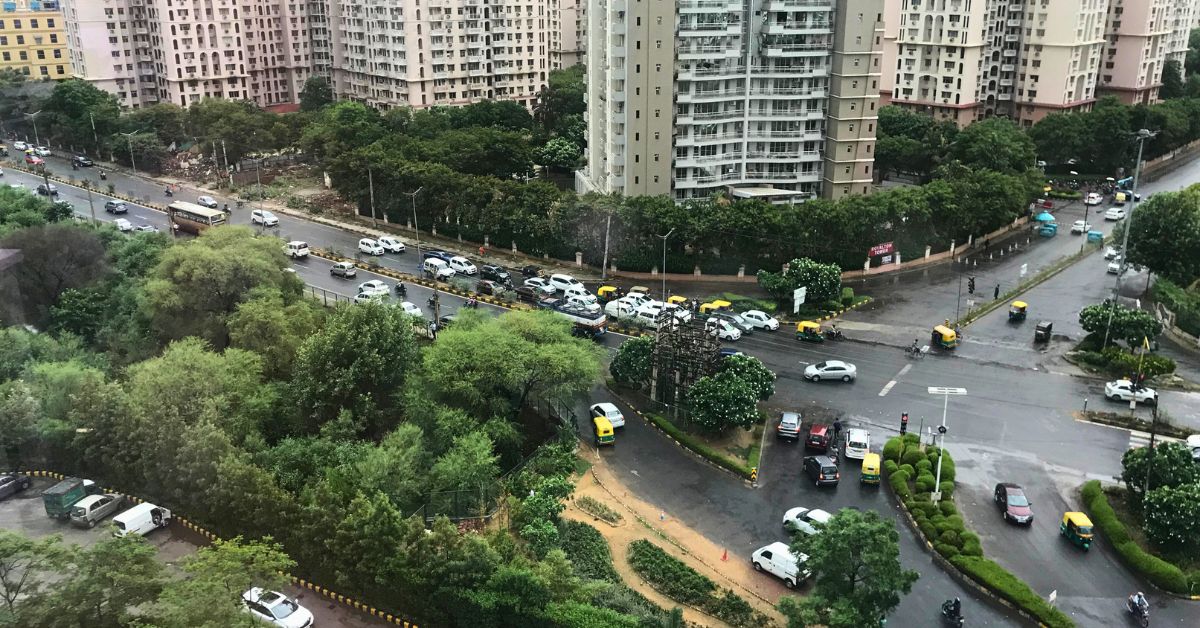
However, this cluster also serves as the epicenter of the corridor’s infrastructure challenges in 2026. Reports from early 2026 indicate that Sector 103 is struggling with “dilapidated roads” and “poor drainage,” where over 3,500 families rely on a single, narrow 5-meter revenue road for expressway access. Similarly, Sector 104 and 102 face frequent sewage overflows and waterlogging due to incomplete master pipeline connections. While the capital values in these sectors have risen by 15-20% due to the highway’s completion, the “livability quotient” remains under severe stress, presenting a short-term risk to rental firming and end-user satisfaction.
Supply and Absorption Analysis: The Premiumization Shift
The 2025–2026 data reveals a structural evolution in Gurgaon’s residential market, characterized by an uncompromising shift toward luxury and high-end segments.
Market Sales and Volume Dynamics (2025)
According to JLL and Cushman & Wakefield reports for Q4 2025, the residential market has shown “remarkable resilience” despite a moderate 11% decline in total sales volume to 270,323 units. This volume adjustment masks a profound shift in market value: properties priced above INR 10 million (1 Crore) now dominate 63% of the total sales, a significant increase from 53% in the previous year.
| Segment | Market Share (2024) | Market Share (2025) | Growth Trend |
| Premium (> INR 10M) | 53% | 63% | Robust Expansion |
| Mid-Segment (INR 5M – 10M) | 35% | 30% | Moderate Contraction |
| Affordable (< INR 5M) | 12% | 7% | Significant Decline |
Developer Pivot and Absorption Profiles
Developers have strategically pivoted toward higher-margin projects to offset rising land and construction costs. In 2025, launches in the INR 15–30 million category grew by 13%, while the INR 30–50 million segment saw a 10% increase. The Dwarka Expressway corridor alone accounted for 27% of all new residential launches in Gurgaon during this period.
The absorption of luxury inventory has been concentrated along the SPR and the Dwarka Expressway, which together contributed 61% of Gurgaon’s luxury absorption in late 2025. SPR contributed 35-38%, while the Dwarka Expressway added 23-26%, reflecting a buyer preference for locations with “infrastructure visibility”. Furthermore, the average unit size for luxury apartments has trended upward, with strong traction for units exceeding 3,000 square feet that offer club-grade amenities.
Gurgaon Real Estate Risk 2026: A Fiduciary Lens On New Launches Vs. Ready Assets
Pricing Analysis: The Parity with Established Corridors
The most critical question for investors in 2026 is whether the Dwarka Expressway’s price appreciation has peaked. The corridor has seen a staggering 3.5x appreciation over the past five years, with average rates moving from INR 6,300 per sq. ft. in 2020 to benchmarks exceeding INR 21,000 per sq. ft. in 2025.
Benchmarking vs. Golf Course Extension and SPR
The Dwarka Expressway is no longer the “affordable alternative” to the Golf Course Extension Road (GCER). In 2025, the average price of an apartment on GCER stood at INR 22,000 per sq. ft., while the Dwarka Expressway micro-market reached an average of INR 18,000 per sq. ft., with fresh launches in prime sectors (106, 113) already crossing the INR 24,000 mark.
| Micro-Market | Avg. Price 2024 (INR/sf) | Avg. Price 2025 (INR/sf) | YoY Growth |
| Dwarka Expressway | ₹9,500 – ₹11,000 | ₹18,000 – ₹24,000 | 29% – 40% |
| Golf Course Ext. | ₹18,000 | ₹22,000 | 22% |
| Southern Peripheral Road | ₹8,500 | ₹12,250 | 29% |
| Golf Course Road | ₹25,000+ | ₹27,200 – ₹35,000 | 10% – 15% |
The “Speculative Narratives” vs. Structural Floors
While the 29% growth in average city-wide prices indicates a robust bull cycle, the Dwarka Expressway’s pricing is now underpinned by “structural floors”—specifically the commissioning of the airport tunnel and the proposed Blue Line metro extension. However, the era of 50% annual gains seen in 2020–2023 is effectively over. Future appreciation is expected to be more measured, in the range of 8% to 15% annually, driven by “livability milestones” rather than project announcements.
Rental Yield and Liquidity Reality in 2026
Institutional investors evaluate real estate through the prism of yield compression and exit liquidity. In 2026, the Dwarka Expressway presents a complex picture of high capital values but developing rental markets.
Rental Yield Benchmarks
Gross rental yields in Gurgaon remain among the highest in the NCR, but the Dwarka Expressway’s yields are currently constrained by the “infrastructure gap.”
- Luxury Segment: Units on the Golf Course Road generate yields of 3% to 4%, while luxury properties on the Dwarka Expressway are currently yielding between 2.5% and 3.5%.
- Mid-Premium Segment: Smaller 2 and 3 BHK units in Sectors 102–104 offer better percentage returns, with annual gross yields in the range of 3.5% to 4.5%.
- Commercial/SCO Plots: Shop-cum-office (SCO) plots along the expressway are witnessing faster rental firming due to the surge in logistics and retail demand near the airport.
Liquidity and Market Maturation
The market has transitioned from a speculative “investor-led” model to a “demand-driven” one.
- Resale Liquidity: High-quality ready-to-move-in (RTMI) inventory is witnessing strong resale demand, particularly in projects by Sobha, DLF, and Tata.
- Investor Holding Periods: AERI advises a holding period of 5 to 7 years for optimum returns. The “short-term flip” is no longer a viable institutional strategy given the current price plateaus.
- The “Flight to Quality”: Buyers are willing to pay a premium for projects with better amenities and delivery track records. Projects with execution delays or “non-cooperating” RERA status are seeing a sharp drop in liquidity.
Risk Matrix: A Nuanced Institutional Perspective
Investing in the Dwarka Expressway in 2026 requires a cold-eyed assessment of risks that are often downplayed in developer marketing.
1. Civic Infrastructure and Last-Mile Neglect
The most immediate risk is the “potholed reality” of the internal sector roads. Despite a 2026 ultimatum from Haryana CM Nayab Singh Saini to fix road craters within 24 hours, local residents continue to report deep craters and “daily commutes turned into risky exercises” in Sectors 83, 84, and 110. The failure of civic agencies (MCG, GMDA, HSIIDC) to maintain basic drainage and sewage infrastructure could lead to a “reputational discount” for even the most premium societies.
2. Luxury Supply Overhang
With over 68,000 residential units in the approval pipeline—of which 64% are in the ultra-luxury category—there is a tangible risk of oversupply in the high-ticket segment. If corporate and NRI demand does not keep pace with launch velocity, price stabilization (or even a marginal correction) could occur in specific micro-pockets.
3. Developer Credit and Execution Risk
The withdrawal of ratings for certain major developers (e.g., ICRA withdrawing M3M India ratings in February 2025) highlights the need for institutional due diligence. Buyers are increasingly gravitating toward “branded” developers with strong balance sheets like Sobha (ICRA AA- Stable) to mitigate project abandonment risks.
| Risk Category | Impact Level | Mitigation Strategy |
| Civic Infra Lag | High (Short-Term) | Focus on projects with direct expressway access. |
| Luxury Overhang | Moderate (Medium-Term) | Target mid-premium units with higher rental demand. |
| Execution Risk | High (Critical) | Stick to Grade-A builders with RERA compliance. |
| Tax/Regulatory | Low (Compliance-based) | Proactive filing of Form 128 for NRI sellers. |
HNI Suitability Analysis: The Shift in Luxury Aspirations
For the HNI segment, the Dwarka Expressway in 2026 is no longer about “affordability,” but about “lifestyle optimization.”
Behavioral Shifts in HNI Buying
Modern luxury buyers in 2026 are prioritizing “wellness-integrated” townships. Preference is shifting toward developments that offer:
- Low-Density Living: HNIs are favoring builder floors and villas in Sectors 111 and 108 that provide more privacy than high-rise clusters.
- Sustainability Certifications: Gated communities with managed green belts and water recycling are commanding a 10-15% premium.
- Connectivity Equity: For high-salaried professionals and “C-suite” executives, the 12-minute airport commute is viewed as a “time-saving asset” that justifies a higher purchase price.
Institutional Advice for HNIs
We recommend that HNIs focus on “Core Sector” assets (Sectors 106 and 113) where social infrastructure like hospitals (Columbia Asia, Medeor) and international schools (DPS, Euro International) is already operational. The “periphery risk” in deeper sectors like 109 or 112 remains high due to delayed municipal connections.
NRI-Specific Analysis: Tax, FEMA, and Repatriation (FY 2025-26)
NRIs remain a cornerstone of the Dwarka Expressway’s demand profile, accounting for a significant portion of luxury absorption. However, the regulatory landscape for FY 2025–26 has introduced new complexities.
1. New Capital Gains Regime (Post-July 2024)
Effective from July 23, 2024, the Indian government has simplified the capital gains tax structure:
- Long-Term Capital Gains (LTCG): Property held for more than 24 months is now taxed at a flat rate of 12.5% without indexation. This replaces the older 20% rate with indexation, which effectively favors properties with high appreciation like those on the Dwarka Expressway.
- Short-Term Capital Gains (STCG): Property held for less than 24 months is taxed at the NRI’s applicable income tax slab rates, which can reach up to 30%.
2. TDS Compliance and the “Form 128” Update
When an NRI sells property, the buyer must deduct TDS at source under Section 195.
- Effective Rates: Including surcharge and cess, the effective TDS rate for LTCG typically ranges from 13% to 14.95%.
- The Form 128 Strategic Remedy: Under the New Income Tax Act, 2025, the older Form 13 has been replaced by Form 128 for requesting a lower or nil TDS certificate. This is a critical tool for NRIs to prevent the “liquidity trap,” where up to 15% of the gross sale value is blocked by the government for months despite lower actual profits.
- Automated Rule-Based Processing: Budget 2026 has proposed an automated process for issuing these certificates to reduce the turnaround time, which currently stands at 21 to 30 days.
3. FEMA Repatriation Limits and Repatriation Strategy
NRIs can repatriate sale proceeds subject to specific annual limits:
- USD 1 Million Limit: Under FEMA, NRIs can remit up to USD 1 million per financial year from their NRO account, covering property sale proceeds and other India-based income.
- Documentation: Repatriation requires the filing of Form 15CA and obtaining Form 15CB from a Chartered Accountant.
- Repatriation Cap on Residential Units: For residential properties, the repatriation of principal is restricted to the sale proceeds of up to two such properties. Any amount beyond this limit or more than two properties requires specific RBI approval.
Scenario Analysis: 2026–2030 Outlook
To provide an advisory-first conclusion, we present three distinct scenarios for the corridor’s performance over the next four years.
Scenario A: The “Institutional Hub” Bull Case
In this scenario, the HSIIDC Global City project (1,000 acres in Sectors 36-37) achieves its Phase 1 completion by December 2026. The successful auction of commercial and mixed-use plots to global firms creates a new “employment magnet” equivalent to Cyber City.
- Outcome: Residential prices in adjacent sectors (102, 106) witness a second surge of 15-20%, while the Blue Line Metro extension becomes operational by 2027, stabilizing yields at 4%.
Scenario B: The “Civic Stagnation” Base Case
In this scenario, the highway remains a high-speed success, but internal infrastructure fixes are slow and reactive. The “Umang Bhardwaj Chowk” bottleneck and sewage issues persist in pockets.
- Outcome: Price appreciation moderates to a “steady-state” CAGR of 8% to 10%. The market becomes highly selective, with “branded” societies in well-connected sectors (106, 113) outperforming the rest of the corridor.
Scenario C: The “Luxury Saturation” Bear Case
If the global economic environment leads to a slowdown in corporate hiring and NRI interest, the massive pipeline of 68,000 units leads to a “supply overhang”.
- Outcome: Secondary market prices face a 5-10% correction, particularly in projects by developers with high debt levels and poor delivery track records. Rental yields compress further as supply outpaces absorption.
Strategic Conclusion: Investment Corridor or Speculative Narrative?
AERI Properties concludes that the Dwarka Expressway in 2026 is a legitimate institutional investment corridor, but it is no longer a “one-size-fits-all” speculative bet. The corridor has entered a phase where value is derived from utility (connectivity) rather than narrative (completion potential).
For the Institutional Investor and HNI:
- Prioritize Execution Certainty: Stick with developers like Sobha and DLF who show AA- credit ratings and healthy cash flows. Avoid “marketing-led” launches with unclear funding structures.
- Focus on the “Zero-km” Cluster: Sectors 111-113 offer the best long-term capital preservation due to their proximity to the Delhi border and the Yashobhoomi infrastructure.
- Audit the Last-Mile: Before any purchase in Sectors 102–104, perform a physical audit of the society’s drainage connection and the status of its 24-meter sector access road. The “Highway to Pothole” transition is the single largest threat to your investment’s livability.
- NRI Fiscal Optimization: NRIs must utilize the Form 128 lower-TDS mechanism to preserve liquidity. With the 12.5% flat LTCG rate, the focus should be on “quality appreciation” over “inflation hedging”.
The Dwarka Expressway is the future urban spine of Gurgaon, but for the 2026 buyer, the “Gold Rush” is over. What remains is a market of discernment, where the quality of the micro-ecosystem is the only true marker of sustainable value.

Join The Discussion