

1. Executive Summary
The transformation of Luxury Real Estate in Gurgaon between 2024 and 2026 represents one of the most significant structural shifts in the Indian property sector. As of early 2026, this segment has evolved from a high-beta satellite town narrative into a primary destination for institutional-grade capital allocation, supported by a rare macroeconomic alignment where India’s GDP growth is projected at 7.3%. This memorandum, prepared by AERI Properties, evaluates the current state of Gurgaon’s premium corridors to determine whether luxury residential assets in this market function as sustainable investment vehicles or primarily as consumption-driven lifestyle premiums.
Strategic Conclusions for the 2026–2030 Cycle
1. The Value-Volume Decoupling: The Indian residential market has entered a phase of “premium dominance.” Total housing sales value across the top seven cities is projected to surge by 20% in FY 2026, exceeding ₹6.65 lakh crore, even as unit sales growth remains stagnant at approximately 4%. Gurgaon is the epicentre of this shift, where high-ticket transactions are now the primary driver of market liquidity.
2. Asset Classification (₹10 Cr+): Ultra-luxury properties have transitioned into Capital Preservation Assets. These function as a physical equity hedge against currency volatility for NRIs and trophy assets with high scarcity value for domestic ultra-HNIs.
3. Infrastructure-Linked Value Floors: Appreciation is no longer sentiment-driven but execution-linked. The completion of the Dwarka Expressway and the 28.5 km Metro extension (Phase I targeted for 2028) have established structural price floors in previously peripheral sectors.
4. Yield Suppression vs. Commercial Alpha: Gross rental yields for luxury residential assets remain compressed in the 3.0%–3.5% range. For yield-seeking allocators, Grade-A commercial office yields (7%–9%) or REITs remain the superior income-generating vehicles.
5. The 2026–2028 Possession Window: A critical liquidity test exists as nearly 131 new housing projects, representing ₹87,000 crore in value, reach completion within the next 24–36 months. This “possession glut” risk may test the depth of the secondary market.
6. NRI Fiscal Friction: Recent tax reforms have introduced significant friction for non-residents. For high-value transactions (>₹5 Cr), the effective Tax Deducted at Source (TDS) under Section 195 can reach 14.95%, substantially impacting net exit IRR.
7. Institutional Holding Horizon: The recommended holding period has extended to 7–10 years. This horizon is necessary to navigate the 2026–2028 delivery wave and capture the secondary phase of infrastructure-led value discovery.
| Strategic Conclusion | Asset Classification | Risk Grading | Target Demographic |
| Capital Preservation | High-End Core (₹10 Cr+) | Low (Volatility) | Ultra-HNIs / Legacy NRIs |
| Appreciation Alpha | Emerging Corridors (₹4-8 Cr) | Moderate (Execution) | HNIs / Tech CXOs |
| Lifestyle Consumption | Gated Communities (₹4-6 Cr) | Moderate (Liquidity) | End-Users / Expats |
2. Defining “Luxury” in Gurgaon: The 2026 Reality
The nomenclature of “luxury” in Gurgaon has undergone a profound inflationary recalibration post-2022. The baseline for luxury entry, historically pegged at ₹2.5 Cr, has shifted toward ₹4 Cr as Grade-A developers pivot toward high-margin, low-density inventory.
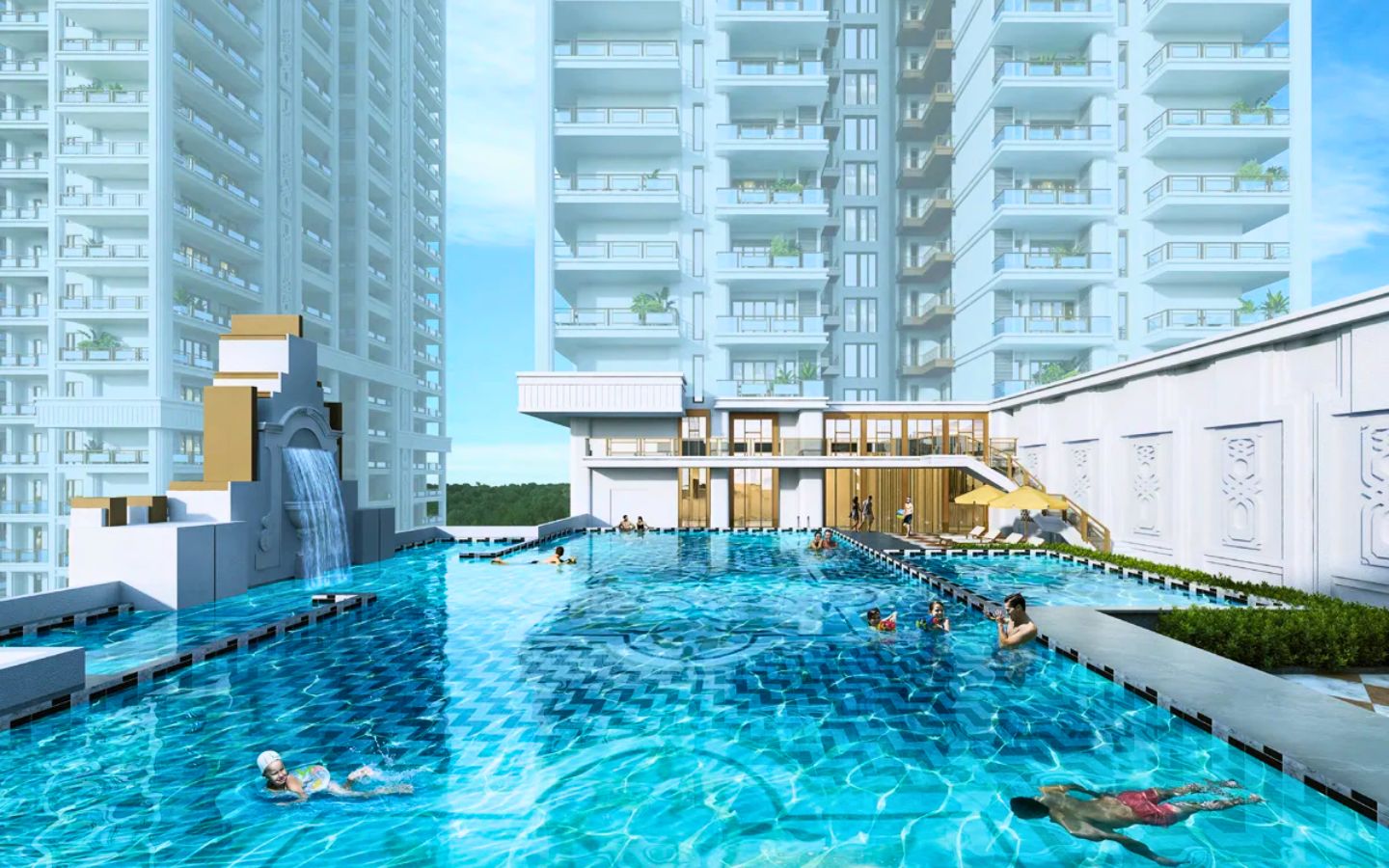
Segmentation by Ticket Size and Benchmarks
Tier 1: Entry-Level Luxury & Gated Communities (₹4–6 Cr)
This segment is predominantly concentrated in New Gurgaon (Sectors 81–95) and the Dwarka Expressway (DXP). These assets cater to upwardly mobile professionals and dual-income families seeking large-scale gated communities with high-security perimeters, clubhouse amenities, and wellness-focused design.
- Price Benchmarks: Stabilized between ₹16,000 and ₹22,000 per sq. ft..
- Core Drivers: Connectivity to IGI Airport and IMT Manesar.
Tier 2: Premium Luxury & Branded Residences (₹6–10 Cr)
Situated along the Golf Course Extension Road (GCER) and Southern Peripheral Road (SPR), this tier represents the “New Gurgaon Core.” These developments emphasize architectural differentiation, “hospitality-branded” services, and lower population density.
- Price Benchmarks: Range from ₹22,000 to ₹35,000 per sq. ft..
- Core Drivers: Proximity to corporate hubs and the emergence of Sector 63/65 as new elite enclaves.
Tier 3: Ultra-Luxury Trophy Assets (₹10 Cr+)
The most exclusive segment, centered on Golf Course Road and DLF Phase V. These assets are characterized by unblockable views (often golf course frontage), extreme scarcity, and a resident profile consisting of the top 0.1% of India’s earners.
- Price Benchmarks: Crossing ₹45,000 per sq. ft., with landmark projects like The Camellias or The Dahlias fetching between ₹1,00,000 and ₹1,46,000 per sq. ft..
- Core Drivers: Status, capital preservation, and peer-group concentration.
Inventory Pipeline: The 2026–2028 Possession Cycle
Haryana RERA (HRERA) filings indicate a robust pipeline. In 2025, 131 new housing projects were registered in Gurgaon, representing ₹87,000 crore in project value. This represents the delivery of inventory sold during the high-velocity launch phase of 2022–2024. The sustainability of current price levels will depend on whether this secondary inventory is absorbed by end-users or if a high percentage of “investor-exits” creates a temporary supply overhang.
3. Price Performance Analysis
Quantitative analysis reveals that Gurgaon has outperformed all other NCR micro-markets in the 2023–2025 cycle, though the velocity of appreciation is beginning to moderate as it enters a phase of structured consolidation.

Micro-Market Compound Annual Growth Rate (CAGR)
| Micro-Market | 3-Year CAGR (Est.) | 12-Month Movement | Avg. Benchmark (₹/sqft) |
| Golf Course Road | 20% – 25% | 12% – 15% | ₹27,200 – ₹60,000 |
| Golf Course Ext. | 22% – 28% | 15% – 18% | ₹19,100 – ₹25,000 |
| Dwarka Expressway | 30% – 35% | 18% – 22% | ₹13,700 – ₹18,500 |
| SPR / New Gurgaon | 18% – 24% | 10% – 14% | ₹10,300 – ₹16,550 |
Infrastructure-Led Appreciation vs. Speculative Spikes
A critical distinction for capital allocators is the foundation of asset value. On the Dwarka Expressway, price growth is fundamentally supported by the operationalization of the 29 km corridor and the upcoming Delhi Metro Phase 4 expansion. Conversely, select pockets in New Gurgaon and SPR have experienced liquidity-led spikes, where price doubling within 24 months has outpaced social infrastructure delivery. These areas are vulnerable to a “time correction”—a period of price stagnation while physical occupancy catches up.
Spread Analysis: Primary vs. Resale
The spread between primary launch prices and resale values has narrowed significantly. Grade-A developers are increasingly “front-loading” future appreciation into launch prices, often commanding a 10%–15% premium over existing resale benchmarks. For investors, this reduces short-term arbitrage potential and reinforces the necessity of a 7-year holding period.
4. Supply & Absorption by Ticket Size
The supply-demand dynamic in Gurgaon is currently characterized by “calculated optimism” from developers and an “aspiration-driven” demand from affluent buyers.
Luxury Absorption Velocity
In FY 2025, luxury homes (₹5 Cr+) accounted for 26% of residential sales nationwide, a dramatic increase from 7% in 2019. Gurgaon remains the preferred destination for luxury in the NCR, contributing 87% of all luxury housing launches in Q3 2025.
| Segment | Launch Volume (Units) | Absorption Velocity (Months) | Unsold Inventory (NCR Est.) |
| ₹5 Cr+ | 12,000+ | 12 – 18 | 8,500 |
| ₹8 Cr+ | 4,500+ | 18 – 24 | 3,200 |
| ₹10 Cr+ | 1,800+ | 24 – 36 | 1,500 |
End-User Driven Maturity
A significant positive indicator for the 2026 market is the shift toward end-user demand. Nearly 60% of buyers in the ultra-luxury tier (₹10 Cr+) are business families or senior corporate professionals who view the property as a legacy residence. This reduces “forced seller” risk during market downturns. However, the ₹4–6 Cr segment remains sensitive to investor sentiment and interest rate cycles.
5. Rental Yield & Liquidity Reality
The viability of Gurgaon luxury residential real estate as an income-producing asset is constrained by the disparity between capital value appreciation and rental growth.

Rental Benchmarks and Suppressed Yields
While absolute rentals have risen by 15%–22% since 2022, capital values in prime corridors have surged by 67%. This has resulted in gross rental yields compressing to historic lows.
| Ticket Size | Typical Monthly Rent | Gross Yield (%) | Net Yield (Est.) |
| ₹5 Cr | ₹1,50,000 – ₹2,25,000 | 3.2% – 3.8% | 2.1% – 2.6% |
| ₹8 Cr | ₹2,50,000 – ₹3,50,000 | 3.0% – 3.4% | 2.0% – 2.4% |
| ₹10 Cr+ | ₹3,50,000 – ₹10,00,000+ | 2.8% – 3.3% | 1.8% – 2.2% |
Comparison with Commercial and Global Markets
For allocators seeking immediate cash flow, Grade-A Commercial Real Estate remains the superior vehicle. Yields for office assets in Cyber City and Golf Course Road range from 7%–9%, supported by a record net absorption of 61 million sq. ft. in 2025.
Global Luxury Yield Comparison (Directional)
- Dubai: Offers gross yields of 6%–9%, with minimal tax leakage on rental income.
- Singapore: Stable gross yields around 3.36%, but high maintenance and tax costs can drop net returns for large units to 1.5%–2%.
- London: Typical gross yields of 2.5%–4%, with net returns often falling below inflation due to high service charges.
Gurgaon’s residential yields are globally competitive in gross terms but suffer from high net friction, particularly for NRIs under Section 195.
Liquidity Depth and Exit Constraints
Liquidity depth for assets above ₹10 Cr is significantly shallower than for mid-segment housing. While signature projects like The Camellias or The Magnolias benefit from extreme scarcity, newer entries in the ultra-luxury tier may face an “illiquidity premium,” requiring marketing periods of 6–12 months for a secondary exit.
6. HNI Allocation Framework (2026)
Strategic capital allocation in the current cycle requires a disciplined approach to portfolio risk as real estate enters a mature phase.

Band 1: Net Worth ₹25–50 Cr
- Appropriate Allocation: 10%–15% of total portfolio.
- Strategy: Lifestyle Upgrade. The asset should be viewed primarily as a consumption choice rather than an investment.
- Advisory: Prioritize ready-to-move (RTM) or near-completion units to minimize execution risk. Avoid high concentration in speculative “pre-launch” corridors.
Band 2: Net Worth ₹50–150 Cr
- Appropriate Allocation: 15%–25% of total portfolio.
- Strategy: Appreciation Alpha & Diversification.
- Tactics: Split allocation between one premium residential asset in GCER/SPR and one commercial yield-producing asset or REIT.
- Holding Period: 7+ Years.
Band 3: Ultra-HNIs (Net Worth ₹150 Cr+)
- Appropriate Allocation: Up to 30%–35% (excluding primary residence).
- Strategy: Capital Preservation.
- Tactics: Focus on ultra-exclusive enclaves with verified golf course frontage or custom villas. These act as “physical equity” with high resilience to broader market corrections.
| Net Worth Band | Role of Real Estate | Liquidity Need | Recommended Asset Tier |
| ₹25-50 Cr | Consumption | High | ₹4-6 Cr (DXP/SPR) |
| ₹50-150 Cr | Strategic Growth | Moderate | ₹6-10 Cr (GCER) |
| ₹150 Cr+ | Preservation | Low | ₹10 Cr+ (GCR) |
7. NRI-Specific Strategic Analysis
NRIs contribute 20%–25% of investments in Gurgaon’s new luxury launches, yet the fiscal environment has become increasingly complex following the 2024-25 budget reforms.
FEMA Compliance and Repatriation
NRIs and OCIs can purchase unlimited residential and commercial properties in India without RBI approval, provided they are not agricultural land or farmhouses.
- Repatriation Cap: Up to $1 million per financial year from the NRO account.
- Lifetime Limit: Full repatriation of principal is permitted for up to two residential properties if purchased using foreign remittance through NRE/FCNR accounts.
Section 195: The TDS and Surcharge Burden (FY 2025-26)
The tax treatment for NRIs is significantly more restrictive than for residents.
- Long-Term Capital Gains (LTCG): 12.5% without indexation (for properties held >24 months).
- TDS at Source: Buyers must deduct TDS on the total sale consideration under Section 195. There is no basic threshold for NRIs.
- Surcharge & Cess: For high-ticket sales, the tax is subject to a surcharge (up to 25% depending on income) and a 4% health and education cess.
Scenario: NRI Selling a ₹10 Cr Property (LTCG)
- Base LTCG Tax: 12.5%
- Surcharge (for income > ₹1 Cr): 15% of tax
- Health & Education Cess: 4% of tax+surcharge
- Effective TDS Rate: 14.95% of the total sale value.
- Note: This is deducted from the gross sale price, not the profit, unless a Lower Deduction Certificate is obtained.
Strategic Suitability for NRIs
- Yield-Seeking NRIs: Gurgaon is Unsuitable. After 31.2% TDS on rental income and high maintenance costs, the net yield often drops below 2%.
- Appreciation-Focused NRIs: Selective Corridors. GCER and SPR offer the potential for 12%+ CAGR capital gains that can offset the high fiscal friction.
- Emotional/Legacy Buyers: Highly Suitable. The luxury gated townships offer parity with global living standards, providing non-financial utility that justifies the fiscal drag.
8. Risk Matrix (Institutional Section)
The current environment in Gurgaon carries structural risks that must be monitored by any capital allocator entering the market in 2026.
| Risk Category | Grading | Institutional Impact |
| A. Liquidity Risk | Elevated | Constrained exit depth for ₹15 Cr+ assets; secondary market saturation during 2026-28 possession wave. |
| B. Supply Risk | Moderate | High volume of simultaneous completions (131 projects) may lead to rental compression and price stagnation in 2027. |
| C. Valuation Risk | Moderate | Prices exceeding ₹25,000/sq.ft. without commensurate rental support create a “time correction” vulnerability. |
| D. Regulatory Risk | Moderate | Potential 8%–77% circle rate hikes in residential zones would increase entry costs and transaction friction. |
| E. Macro Risk | Low/Mod | Sensitivity to GCC (Global Capability Centre) expansion; a slowdown in tech leasing would hit premium occupancy. |
9. Recent Circle Rate Revisions (2025-2026)
Circle rates serve as the minimum value at which properties must be registered. The Haryana government has revised these rates upward by 10%–30% in 2025-26 to reflect actual market values.
| Area / Sector | 2024 Circle Rate (psf) | 2025-26 Circle Rate (psf) | % Change |
| DLF Phase II (Plots) | ₹1,00,000 | ₹1,15,100 | 15% |
| Sector 54 (Camellias/Magnolias) | ₹37,750 | ₹39,325 | 4% |
| Sector 49 (Vatika City/Elan) | ₹8,500 | ₹9,100 | 7% |
| Sector 104-115 (DXP Zone) | ₹4,200 | ₹7,000 | 67% |
| Sector 63-68 (SPR Zone) | ₹6,000 | ₹7,500 | 25% |
10. Scenario Analysis (2026–2030)
Modeling the future of Gurgaon requires balancing unprecedented wealth creation against the risks of price over-expansion.
Base Case: Structured Maturity (Probability: 55%)
- Assumptions: India maintains 6.5%+ GDP growth; steady infrastructure delivery (Metro Phase 4/SPR widening); repo rate reductions easing affordability.
- Outcome: Property prices grow at 8%–12% annually. Speculative investors are replaced by long-term end-users and institutional capital.
- Price Range: Golf Course Road averages ₹70,000–₹85,000/sq.ft. by 2030.
Bull Case: The Global Tech-Hub (Probability: 25%)
- Assumptions: Global capital inflow into GCCs exceeds 60 million sq. ft./year; rapid operationalization of the Delhi-Mumbai Expressway; robust equity market gains.
- Outcome: Gurgaon becomes the “South Mumbai of North India.” Scarcity drives a price spiral. Prime corridors cross ₹1.5 lakh/sq.ft..
Stress Case: The Liquidity Squeeze (Probability: 20%)
- Assumptions: Global credit tightening; domestic repo rate reversal; “secondary market glut” from 2022-era launches hitting the market simultaneously.
- Outcome: Prices remain stagnant or experience a 5%–10% “time correction.” Transaction volumes drop by 30%. Rental yields expand as owners lease units they cannot sell.
11. Strategic Conclusion
Gurgaon’s luxury real estate has matured from a high-beta growth market into a complex asset class requiring institutional discipline. For the current cycle (2026–2030), the advisory stance of AERI Properties emphasizes selectivity and liquidity management.
Advisory Stance: Luxury property in Gurgaon remains a viable Asset Class for those with a 7–10 year horizon, provided the focus is on “de-risked” premium corridors with high end-user participation (e.g., GCER, Sector 54, and DXP Sectors 102-113). For those with shorter horizons or high liquidity needs, the current valuations represent a Lifestyle Upgrade with significant concentration risk.
Capital Allocation Discipline:
- Selectivity: Avoid “me-too” high-density projects in oversupplied sectors of New Gurgaon. Focus on low-density, branded developments in Golf Course Extension and SPR.
- Fiscal Prudence: NRIs must factor in the 15%+ TDS friction and the removal of indexation when calculating net IRR. Real estate should only be pursued if the anticipated appreciation exceeds a 12% CAGR.
- Yield Expectations: Investors seeking cash flow should prioritize Grade-A commercial REITs or office assets (7%–9% yield) rather than luxury residential units.
- Holding Horizon: Adhere to a minimum of 7 years to weather the 2026–2028 possession wave and capture full infrastructure maturity.
Gurgaon remains the nucleus of India’s premium real estate narrative. However, the era of unbridled, city-wide appreciation has been replaced by a corridor-specific performance model, where success is determined by asset quality, developer governance, and infrastructure proximity.

Join The Discussion