
Understanding the Micro-Market Before the Property
We analyse infrastructure, employment hubs, and connectivity to identify high-growth micro-markets.
AERI Real Estate Investment Framework
- ① Developer Governance →
- ② Legal Integrity →
- ③ Micro-Market Fundamentals →
- ④ Supply–Demand Balance →
- ⑤ Exit Liquidity →
03. Micro-Market Fundamentals
Evaluating the Economic Engine Behind a Real Estate Investment
A well-designed project in the wrong micro-market rarely delivers strong long-term outcomes.
Real estate performance is shaped by the economic and infrastructure dynamics of a specific corridor — including employment hubs, connectivity, and long-term urban development patterns.
At AERI Properties, we analyse micro-markets to identify locations where employment growth, infrastructure investment, and residential demand are structurally aligned.
This ensures property decisions are based on long-term urban fundamentals rather than short-term market sentiment.
Drivers of Micro-Market Strength
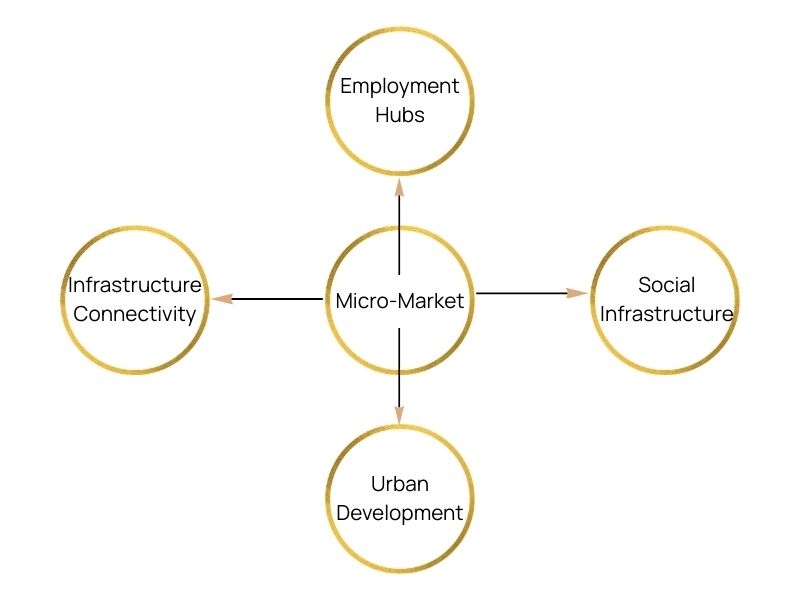
Why Micro-Markets Matter in Real Estate Investing
In large metropolitan markets, real estate growth is rarely uniform across the entire city.
Instead, it concentrates along specific development corridors where infrastructure investment, employment hubs, and residential demand converge.
These corridors form distinct micro-markets, each with its own demand drivers, buyer profiles, and long-term growth trajectory.
Understanding these dynamics is essential when evaluating a property’s long-term investment performance.
How AERI Evaluates Micro-Market Fundamentals
Before recommending any investment opportunity, AERI Properties evaluates the underlying micro-market fundamentals through a structured framework designed to assess demand drivers, infrastructure momentum, and long-term urban growth.
01 Employment Hubs & Economic Density
Sustained residential demand typically follows concentrations of employment and business activity within a corridor.
Commercial Absorption Trends
We track the expansion of Grade-A office districts and leasing activity across corporate hubs, as commercial growth often precedes residential demand.
Occupier Quality
Corridors anchored by multinational companies, Global Capability Centers, and technology firms tend to attract higher-income tenants and long-term homebuyers.
02 Infrastructure & Connectivity Corridors
Infrastructure investment can fundamentally reshape a corridor’s long-term growth trajectory.
Upcoming Infrastructure Impact
We analyse metro expansions, expressways, and major transport upgrades that improve connectivity to employment districts.
Time–Distance Accessibility
Rather than physical distance, we evaluate how quickly residents can reach business districts, airports, and city infrastructure.
03 Social Infrastructure & Residential Ecosystem
High-quality residential demand is sustained by a well-developed social ecosystem.
Institutional Proximity
Access to reputable schools, hospitals, and educational institutions significantly influences long-term residential desirability.
Lifestyle Ecosystem
Organised retail, dining districts, and recreational spaces contribute to the long-term attractiveness of a residential corridor.
04 Future Growth & Urban Planning Alignment
Long-term investment performance is influenced by how closely a corridor aligns with future urban development plans.
Master Plan & Zoning
We evaluate land-use regulations, density plans, and development zoning that could affect the long-term character of the corridor.
Infrastructure Development Timelines
Mapping infrastructure completion schedules against investment timelines helps identify locations positioned for structural growth.
Together, these four factors help determine whether a micro-market is positioned for sustainable demand, capital appreciation, and long-term exit liquidity.
Deep Micro-Market Coverage in Gurgaon
Gurgaon’s real estate market is highly corridor-driven, with each major development belt functioning as a distinct micro-market with its own demand dynamics.
AERI Properties maintains focused advisory coverage across Gurgaon’s most important residential corridors, including:
- Dwarka Expressway
- Golf Course Road
- Golf Course Extension Road
- Southern Peripheral Road (SPR)
- New Gurgaon
Within each corridor, our ongoing analysis tracks infrastructure progress, supply pipelines, and buyer absorption trends.
This allows us to evaluate investment opportunities based on the structural strength and long-term demand drivers of the micro-market itself.
AERI Insight
Traditional real estate advice focuses on where people live today.
The AERI investment framework focuses on where infrastructure investment and high-value employment will shape residential demand tomorrow.
Capital Appreciation
Corridors supported by infrastructure investment and employment growth typically deliver stronger long-term capital appreciation.
Rental Demand
Proximity to major business districts supports deeper and more stable rental demand.
Exit Liquidity
Properties located in economically active micro-markets attract a broader pool of future buyers and stronger resale liquidity.
Next Dimension in the AERI Investment Framework
Understanding the micro-market is only one part of disciplined real estate investing.
The next step is evaluating supply and demand dynamics within the corridor.
Explore Supply–Demand Balance →
Request a Private Advisory Conversation
AERI Properties works with a limited number of clients at a time to ensure focused advisory engagement.
Conversations are confidential, exploratory, and designed to evaluate whether a real estate opportunity aligns with your investment objectives.
Typical response time: within one business day.